By The Worldonomics Times
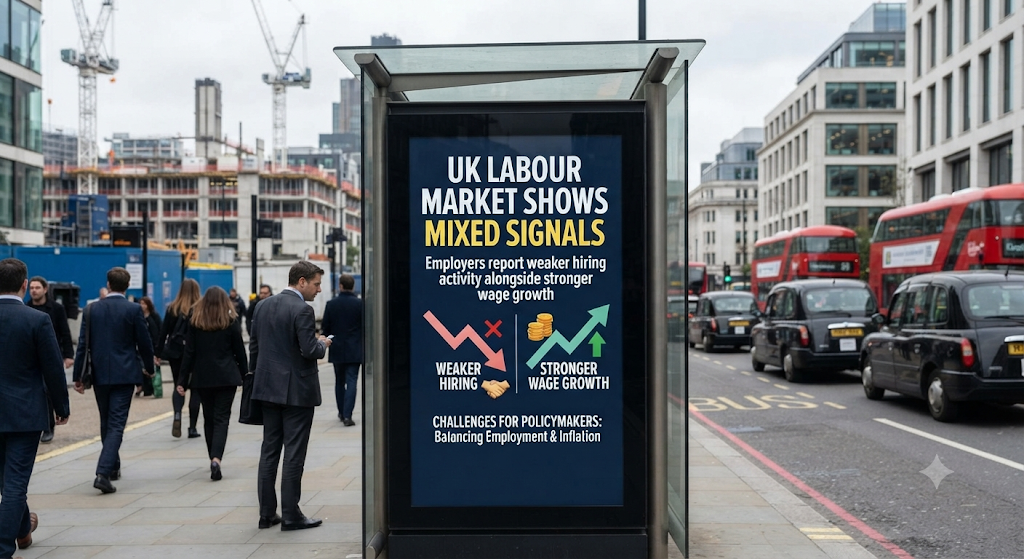
The United Kingdom’s labour market is presenting a complicated picture as employers become more cautious about recruitment while wage pressures remain a concern. Businesses are reporting weaker hiring activity amid rising operating costs and economic uncertainty. At the same time, competition for skilled professionals is supporting higher starting salaries in certain sectors, creating challenges for employers and policymakers.
These developments highlight the difficulty of balancing employment growth with inflation control. While a slower labour market can help reduce demand-driven inflation, continued wage pressures may make it harder for the Bank of England to bring inflation under control without weakening economic activity further.
Hiring Activity Shows Signs of Weakness
Recent employment figures indicate that businesses are becoming more selective about recruitment. According to the Office for National Statistics (ONS), the number of UK job vacancies declined by 22,000, or 3%, to approximately 690,000 in the August–October 2026 period. Vacancies were also 5% lower than a year earlier.
The decline was recorded across 11 of the 18 industry sectors, with construction, administrative services and transportation among the areas experiencing notable reductions. Smaller businesses faced particularly significant pressure, reflecting concerns about labour expenses and wider operating conditions.
The latest recruitment survey from KPMG and the Recruitment and Employment Confederation (REC) also showed that permanent job placements fell in October for the first time in four months. Employers cited economic uncertainty and rising costs as reasons for delaying or reducing recruitment plans.
Although overall vacancies declined at a slower pace than in previous months, the survey indicated that businesses remained cautious about expanding their workforces.
Wage Growth Remains an Important Concern
Wage developments are creating another challenge for the UK economy. Employers in certain sectors are offering higher starting salaries to attract skilled candidates, even as overall recruitment activity weakens.
The October KPMG and REC survey reported stronger increases in starting salaries for permanent and temporary positions. However, the pace of growth remained below historical averages, suggesting that pay pressures were present but not widespread across the entire labour market. <Cite refs={[“turn784255search2”]}/>
Official figures provide a slightly different picture. The ONS reported that annual growth in regular earnings, excluding bonuses, slowed to 3.5% in July–September 2026, compared with 3.7% in the previous three-month period. Total pay growth also eased to 3.6%.
Private-sector regular pay increased by 3.1%, while public-sector pay rose by 5.4%, partly reflecting the timing of salary awards.
The difference between average earnings and starting salaries is important. While overall wage growth is moderating, businesses recruiting for specialised positions may still need to offer competitive packages to attract suitable candidates.
Economic Uncertainty Influences Employer Decisions
Several economic factors are influencing recruitment decisions across the United Kingdom.
Higher operating expenses, energy costs, borrowing rates and uncertainty about future consumer demand are making businesses more cautious about expansion. Employers must consider whether additional recruitment is financially sustainable before committing to long-term salary obligations.
Smaller companies are particularly exposed because they often have fewer financial resources to absorb higher employment costs. Some businesses are choosing to maintain existing staffing levels, delay new appointments or rely more heavily on temporary workers.
The Chartered Institute of Personnel and Development’s November 2026 Labour Market Outlook also found that employer confidence remained weak. Its survey indicated that only 58% of private-sector employers planned to recruit during the following three months.
These developments suggest that employment demand may remain subdued unless business confidence and economic conditions improve.
Impact on Inflation and Monetary Policy
The relationship between employment and inflation is a major concern for the Bank of England.
When wages increase rapidly, businesses may face higher labour expenses. Companies can respond by accepting lower profit margins, improving productivity or increasing prices. If higher wages are passed on to consumers, inflation may remain elevated.
However, weakening recruitment and slower employment growth can reduce pressure on wages over time. This may help the central bank manage inflation without requiring additional monetary tightening.
The Bank of England’s November 2026 Monetary Policy Report noted that underlying wage growth remained relatively elevated, although forward-looking indicators suggested some moderation. It also highlighted the possibility that higher energy prices could influence future wage expectations and salary negotiations.
The challenge for policymakers is to determine whether wage pressures are becoming sufficiently moderate to support lower inflation without causing a significant deterioration in employment.
Young Workers Face Greater Employment Challenges
A weaker recruitment environment can create particular difficulties for young people and individuals entering the workforce for the first time.
When companies reduce hiring, entry-level opportunities may become less available. Graduates and inexperienced workers can face greater competition for vacancies, while employers may prioritise candidates with established skills and professional experience.
Bank of England Deputy Governor Clare Lombardelli highlighted this issue in a November 10 speech. She explained that the UK labour market was cooling mainly through weaker hiring rather than increased redundancies. She also warned that reduced job mobility could particularly affect younger workers and limit productivity growth.
The growing adoption of artificial intelligence is adding another dimension to the challenge. Businesses are changing the skills they require, making digital knowledge, technical capabilities and adaptability increasingly important for future employment opportunities.
Implications for India
Developments in the UK labour market are relevant to India because the two economies maintain important commercial and employment connections.
Indian professionals working in technology, finance, healthcare, consulting and other service industries may be affected by changes in British recruitment demand. Indian IT and outsourcing companies also depend on business investment and technology spending in the UK.
A slowdown in British hiring and economic activity could make some companies more cautious about outsourcing contracts and new technology projects. However, demand for specialised digital skills, engineering services and artificial intelligence solutions may continue to create opportunities.
For Indian businesses operating in the UK, understanding changes in employment costs, consumer demand and monetary policy will be important when making investment and workforce decisions.
The Worldonomics Times View
The UK labour market is showing signs of gradual adjustment rather than a sudden employment crisis. Recruitment activity is weakening, vacancies are declining and businesses are becoming more cautious about workforce expansion. At the same time, competition for specialised skills continues to support starting salaries in certain sectors.
For policymakers, the priority is to reduce inflation while preserving employment opportunities and encouraging sustainable business growth. Improving workforce skills, supporting small businesses and strengthening productivity will be essential to achieving this balance.
For employers, investment in training, technology and efficient workforce planning can help manage rising costs while maintaining competitiveness.
Ultimately, the strength of the UK labour market will depend on the country’s ability to restore business confidence, create new employment opportunities and ensure that wage growth remains consistent with sustainable economic expansion.