Semiconductor Demand and Export Growth Are Playing a Significant Role in South Korea’s Economic Performance
THE WORLDONOMICS TIMES
Special Economic and International Trade Report | November 2026
Introduction: The Semiconductor Industry Powers South Korea’s Export Success
South Korea is strengthening its position as one of the world’s most important technology-exporting economies, supported by exceptional growth in semiconductor demand and international shipments. The expansion of artificial intelligence (AI), cloud computing, high-performance computing and advanced data-centre infrastructure has created significant demand for memory chips and other semiconductor products. South Korean manufacturers are benefiting from this transformation, making the semiconductor industry one of the strongest contributors to the country’s economic performance in 2026.
The scale of the export expansion is remarkable. On 19 November 2026, South Korea’s cumulative exports crossed US$1 trillion for the first time, making it the fourth economy in the world to achieve this milestone, following the United States, China and Germany. The achievement came earlier than the end of the year and reflected the strength of the country’s technology-related exports, particularly semiconductors and computers.
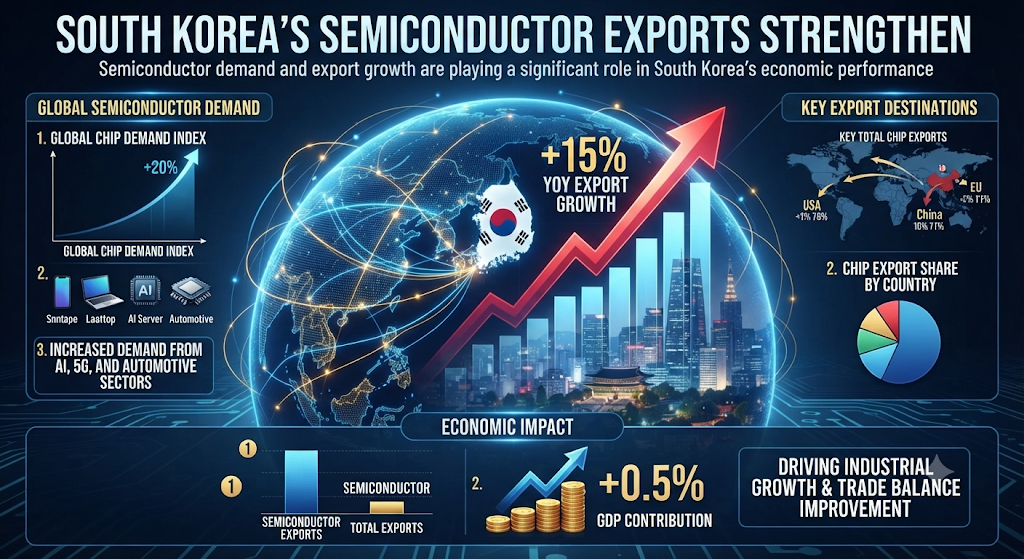
According to South Korea’s Ministry of Trade, Industry and Resources, semiconductor exports reached approximately US$397.7 billion during January–October 2026, nearly three times the US$135.4 billion recorded during the corresponding period of 2025. Semiconductors accounted for approximately 42.7% of the country’s total exports during this period. This demonstrates the extraordinary importance of the chip industry to South Korea’s international trade performance.
The October figures further illustrate the strength of the trend. South Korea’s total exports reached approximately US$115.28 billion, representing year-on-year growth of 93.7%. Semiconductor exports alone increased by approximately 259.4% to US$56.44 billion. The country’s trade surplus reached US$42.50 billion, while cumulative exports for January–October reached US$930 billion.
The rapid expansion has been driven by strong international demand for high-performance memory, particularly products used in AI servers and data centres. Technology companies across the world are investing heavily in computing infrastructure, creating a growing market for advanced memory and storage technologies.
South Korea has an important competitive advantage in this environment. Its semiconductor manufacturers possess extensive expertise in memory production, advanced manufacturing, research and development, and large-scale industrial operations. Companies such as Samsung Electronics and SK hynix have become important suppliers to international technology businesses.
However, the current export boom is more than a success story for two major companies. It is influencing South Korea’s industrial investment, trade balance, manufacturing activity, technology ecosystem and economic growth prospects.
At the same time, the extraordinary dependence on semiconductor exports raises important questions about the sustainability of growth. The industry is cyclical, international competition is increasing, and geopolitical tensions can affect access to markets, technology and production equipment.
The central challenge for South Korea is therefore to convert the present semiconductor opportunity into long-term economic strength through innovation, diversification, skilled employment and a competitive domestic industrial ecosystem.
1. South Korea Reaches the US$1 Trillion Export Milestone
South Korea’s achievement of US$1 trillion in cumulative exports during 2026 represents a major milestone in its economic development.
For decades, the country has followed an export-oriented industrial strategy. Its economic transformation has been supported by manufacturing, technological development, international trade and the growth of globally competitive companies.
South Korea has developed strong industries in automobiles, shipbuilding, steel, petrochemicals, electronics, batteries, machinery and consumer technology. Semiconductors have increasingly become one of the most valuable elements of this industrial structure.
Crossing the US$1 trillion export threshold demonstrates the scale of South Korea’s integration into international markets. It also highlights the importance of technology-intensive manufacturing in the country’s modern economy.
The milestone was reached on 19 November, when cumulative exports crossed the threshold at approximately 2:09 p.m. local time, according to the country’s industry ministry.
The achievement followed a strong 2025, when South Korean exports reached approximately US$709.3 billion. The acceleration during 2026 was largely associated with exceptional demand for semiconductors and computers as major technology companies increased their investment in AI infrastructure.
The growth was not limited to one destination. South Korean exports increased across major markets, including the United States, China, Japan, the European Union and Southeast Asia. Emerging markets, including India and countries in Latin America, also offered additional opportunities.
Nevertheless, semiconductors were the principal driver of the expansion. The country’s industry ministry has highlighted the importance of memory-chip prices and AI-related investment in supporting export values.
The milestone also reflects the broader transformation of international trade. Technology products are increasingly influencing the value and direction of global merchandise exports. Countries with advanced semiconductor manufacturing capabilities are gaining strategic importance because chips are essential components of modern economic infrastructure.
For South Korea, the challenge is to ensure that the export milestone becomes the foundation for continued industrial development rather than a temporary result of a favourable semiconductor cycle.
2. Why Global Semiconductor Demand Is Increasing
The global semiconductor industry is experiencing a significant transformation as businesses, governments and technology companies adopt increasingly advanced digital systems.
Semiconductors are essential components in almost every modern electronic device. They are used in smartphones, computers, vehicles, telecommunications networks, medical equipment, industrial machinery and consumer electronics.
Their importance has increased further because of AI and high-performance computing.
Modern AI systems require enormous processing capacity and access to large amounts of data. Training sophisticated AI models involves extensive calculations, while operating those models for everyday applications requires high-speed communication between processors, memory and storage systems.
These requirements are creating strong demand for advanced semiconductor products.
Artificial intelligence infrastructure
Technology companies are investing heavily in data centres designed to support AI training, inference, cloud services and enterprise applications.
These facilities require powerful processors, specialised accelerators, high-bandwidth memory, networking components and high-capacity storage.
The construction of AI data centres has therefore created an important new source of demand for semiconductor manufacturers.
South Korean producers are particularly well positioned in the memory segment of this market.
High-performance computing
High-performance computing is used in scientific research, engineering, weather forecasting, financial modelling, advanced manufacturing and national research programmes.
These applications require systems capable of processing enormous volumes of information.
As computing workloads become more demanding, manufacturers need faster and more efficient memory technologies.
This is increasing the importance of advanced DRAM, HBM and specialised storage products.
Cloud computing
Cloud computing allows businesses and individuals to access computing resources through remote data centres.
The expansion of cloud services requires investment in servers, storage devices, networking infrastructure and memory components.
As businesses increasingly use AI tools through cloud platforms, demand for supporting semiconductor products continues to rise.
Digital transformation
Banks, hospitals, educational institutions, manufacturing companies and government agencies are adopting digital technologies to improve productivity and service delivery.
This transformation creates demand for electronic equipment, data processing systems and connected devices.
The semiconductor industry benefits because every expansion in digital infrastructure requires additional chips.
Automotive technology
Modern vehicles contain increasingly sophisticated electronic systems.
Advanced driver-assistance systems, navigation, infotainment, battery management, power electronics and connected-car technologies all require semiconductor components.
The expansion of electric vehicles and automated driving systems is creating additional long-term demand.
3. High-Bandwidth Memory: The Centre of the AI Semiconductor Boom
One of the most important developments in the semiconductor industry is the increasing demand for high-bandwidth memory, commonly known as HBM.
HBM is a specialised memory technology designed to transfer large volumes of data at very high speeds.
It is particularly important for AI accelerators and advanced computing systems because modern processors require rapid access to large datasets.
Traditional memory architectures can create bottlenecks when powerful processors must continuously receive and transfer information. HBM helps reduce these bottlenecks by providing high data-transfer capacity and close integration with advanced processors.
This makes it particularly valuable in AI servers, where performance depends not only on processing power but also on how efficiently data can move between components.
Why HBM is important
AI models require access to extensive parameters and datasets. During training and inference, processors repeatedly exchange information with memory systems.
If memory bandwidth is insufficient, even a powerful processor may not operate at its full potential.
HBM helps improve overall system performance by enabling faster data movement.
The technology also requires advanced manufacturing and packaging capabilities, making it a specialised and valuable part of the semiconductor supply chain.
South Korea’s competitive position
South Korean manufacturers have invested heavily in advanced memory technologies.
SK hynix has developed a strong position in the HBM market, while Samsung Electronics is investing in next-generation memory products, advanced packaging and manufacturing processes.
Their capabilities make South Korea an important supplier to international companies developing AI accelerators and high-performance computing systems.
Economic importance
The growing HBM market provides opportunities beyond the direct sale of memory chips.
It creates demand for semiconductor materials, precision equipment, advanced packaging, inspection systems and specialist engineering services.
The expansion of this segment can therefore support investment throughout South Korea’s domestic semiconductor ecosystem.
4. Samsung Electronics: A Major Pillar of South Korea’s Technology Industry
Samsung Electronics is one of the most influential technology companies in the world and a central participant in South Korea’s semiconductor industry.
Its operations cover memory chips, logic semiconductors, foundry services, mobile devices, displays and consumer electronics.
The company’s semiconductor business supplies products used in computers, servers, smartphones, automotive systems and other digital applications.
Samsung’s scale provides several competitive advantages.
First, it operates large manufacturing facilities and has substantial experience in semiconductor production.
Second, its investment in research and development allows it to develop new memory architectures and manufacturing processes.
Third, its position across several technology markets provides opportunities to connect semiconductor development with other electronic products and systems.
Memory manufacturing
Samsung is a major global producer of DRAM and NAND flash memory.
DRAM is used as working memory in servers, computers and smartphones. NAND is used in storage devices, including solid-state drives.
The expansion of AI infrastructure has increased the importance of both technologies.
AI servers require substantial memory capacity, while data centres need high-capacity storage for datasets, software and digital information.
Advanced memory and packaging
The company is also investing in HBM and advanced packaging technologies.
These areas are becoming increasingly important because AI computing requires close integration between processors and memory.
The ability to manufacture and package advanced semiconductor products will influence Samsung’s competitiveness in the next phase of AI development.
International importance
Samsung’s semiconductor operations are closely connected to global technology companies.
Its products contribute to international electronics manufacturing and digital infrastructure, while its manufacturing investments support a large network of suppliers and industrial services.
The company’s performance therefore has significance beyond South Korea’s domestic economy.
5. SK hynix and Its Role in the Global HBM Market
SK hynix is another major pillar of South Korea’s semiconductor industry.
The company specialises in memory products, including DRAM and NAND flash, and has become particularly important in high-bandwidth memory.
The expansion of AI computing has increased demand for advanced memory products, creating significant opportunities for SK hynix.
Focus on advanced memory
HBM is increasingly used in AI accelerators because of its high data-transfer capacity.
As technology companies develop more powerful AI systems, the memory requirements of these systems become more demanding.
SK hynix’s investments in HBM development and manufacturing have helped strengthen its position in this market.
Investment in production capabilities
Meeting demand for advanced memory requires investment in manufacturing equipment, packaging technologies, quality control and production capacity.
SK hynix must continue improving its capabilities to maintain competitiveness as the market evolves.
Wider economic contribution
The company’s activities support employment, research and development, capital investment and demand for specialist suppliers.
Its performance also strengthens South Korea’s position in the global semiconductor supply chain.
6. DRAM and NAND: The Foundation of Memory Exports
South Korea is a major producer of memory semiconductors, particularly DRAM and NAND flash.
These technologies are essential to modern computing and digital infrastructure.
DRAM: Supporting computing performance
Dynamic random-access memory, or DRAM, is used as temporary working memory in computers, servers and electronic devices.
It allows processors to access information quickly while performing calculations.
Demand for server DRAM has strengthened because AI servers require substantial memory capacity and high-speed data access.
The October 2026 ICT export report highlighted strong demand for high-performance memory and continued tightness in DRAM supply.
Higher memory prices have also contributed to the increase in export values.
NAND: Supporting data storage
NAND flash memory is used in solid-state drives, smartphones, computers and enterprise storage systems.
The expansion of AI data centres has increased demand for high-capacity storage devices.
AI systems generate and process large quantities of information, requiring reliable storage infrastructure.
South Korean producers benefit from this demand through exports of memory chips and storage-related products.
The importance of memory prices
Memory markets are cyclical.
When demand exceeds supply, prices can rise sharply. When manufacturers expand capacity faster than consumption grows, prices may fall.
The current export boom has benefited from strong demand and higher prices.
However, companies must carefully manage production capacity because excessive investment could create oversupply in the future.
7. AI Infrastructure Investment and Its Impact on South Korean Exports
The global expansion of AI infrastructure has become one of the strongest drivers of semiconductor demand.
Technology companies are investing in large data centres to develop and operate advanced AI systems.
These facilities require processors, memory, storage, networking equipment, cooling systems and electricity infrastructure.
The construction of an AI data centre therefore creates demand across several industries.
South Korean semiconductor manufacturers supply important memory and storage components used in these facilities.
International technology investment
Major technology companies are increasing their spending on AI-related infrastructure because they expect AI services to become an important source of future business revenue.
The investment covers:
- AI training facilities.
- Cloud computing infrastructure.
- High-performance servers.
- Advanced memory systems.
- Networking and data-transfer equipment.
- Enterprise storage.
- Cooling and power-management technologies.
As these projects expand, semiconductor demand increases.
The multiplier effect
The economic benefits extend beyond semiconductor manufacturers.
Higher chip production requires more manufacturing equipment, materials, transportation and industrial services.
This creates additional demand for domestic suppliers and international trading partners.
The result is a multiplier effect in which investment in one part of the technology industry supports activity across several related sectors.
The sustainability question
AI infrastructure investment is currently a major growth driver, but its long-term sustainability will depend on the commercial success of AI applications.
If businesses generate sufficient productivity improvements and revenue from AI, infrastructure investment could continue expanding.
If returns fall short of expectations, technology companies may reconsider their spending plans.
South Korea must therefore prepare for both continued growth and possible market adjustments.
8. Semiconductor Exports and South Korea’s GDP Growth
The semiconductor industry has become an important contributor to South Korea’s economic growth.
Strong exports generate foreign-currency earnings, support manufacturing activity and encourage investment in production facilities.
The Bank of Korea’s advance estimates showed that South Korea’s real GDP increased by 1% in the third quarter of 2026 compared with the previous quarter. Year-on-year growth reached 3.4%.
Exports increased 2.3% quarter on quarter, while facilities investment rose 4.1%, supported by spending on machinery and semiconductor-related equipment.
The semiconductor upturn was an important contributor to the improved performance.
Contribution through exports
When semiconductor exports increase, manufacturers receive additional orders from international customers.
They expand production, increase shipments and purchase more materials and services.
This supports industrial activity and contributes to national income.
Contribution through investment
Strong demand encourages companies to invest in new manufacturing facilities, advanced machinery and research capabilities.
These investments create demand for construction, engineering, equipment and specialised services.
Contribution through productivity
Semiconductor development can also improve productivity in other industries.
Advanced chips support automation, AI applications, data analysis and digital manufacturing.
These technologies can help businesses improve efficiency and develop new products.
Uneven economic benefits
Despite strong export growth, the benefits are not automatically shared equally across the economy.
The third-quarter data showed that private consumption declined 0.2% quarter on quarter.
This indicates that the technology export boom and domestic household conditions can move at different speeds.
The long-term objective should be to ensure that export growth supports stronger wages, employment, investment and domestic demand.
9. The Impact on South Korea’s Trade Balance
Semiconductor exports have made a significant contribution to South Korea’s trade surplus.
In October 2026, total exports reached approximately US$115.28 billion, while imports were approximately US$72.78 billion.
This resulted in a trade surplus of approximately US$42.50 billion.
The cumulative surplus for January–October reached approximately US$294.9 billion.
The expansion of semiconductor exports was a major factor behind this result.
Foreign-exchange earnings
Exports generate foreign-currency receipts that support the country’s external financial position.
Strong export earnings can improve confidence in the economy and support international investment.
Import requirements
Semiconductor manufacturing also requires imported machinery, chemicals, materials and specialised components.
As production increases, imports of semiconductor equipment can rise.
The October 2026 trade data showed an increase in imports of semiconductor manufacturing equipment.
This demonstrates that semiconductor-led growth involves both higher exports and higher imports.
Domestic value creation
The overall economic benefit depends on how much value is created domestically.
Research, engineering, production, packaging, testing and supplier activities can increase the domestic contribution of semiconductor exports.
Strengthening local capabilities can therefore improve the long-term benefits of international trade.
10. South Korea’s Position in the Global Semiconductor Supply Chain
Semiconductor manufacturing is one of the world’s most complex international industries.
The production of a modern chip may involve design work in one country, specialised materials from another, manufacturing equipment from several suppliers, fabrication in a semiconductor plant, advanced packaging elsewhere and final integration into electronic products.
South Korea occupies an important position in this network, especially in memory production.
Its industrial strengths include:
- Large-scale DRAM manufacturing.
- NAND flash production.
- High-bandwidth memory development.
- Advanced semiconductor research.
- Precision manufacturing.
- Packaging and testing capabilities.
- A specialised engineering workforce.
- Established global customer relationships.
The country is closely connected with the United States, Taiwan, Japan, China and Europe.
These relationships allow South Korean companies to participate in international technology development and supply chains.
However, they also expose the industry to global trade restrictions, geopolitical risks and changes in international investment patterns.
11. Taiwan, the United States, Japan and China: The Competitive Landscape
South Korea operates in a highly competitive global semiconductor industry.
Other economies possess significant strengths in different parts of the supply chain.
Taiwan: Advanced foundry manufacturing
Taiwan is a major centre for advanced semiconductor foundry manufacturing.
Its companies produce sophisticated logic chips used in AI accelerators, processors and electronic devices.
South Korea and Taiwan are both essential to the global semiconductor ecosystem, although their areas of specialisation differ.
United States: Chip design and technology development
The United States has major strengths in semiconductor design, chip architecture, software ecosystems and manufacturing equipment.
American technology companies are among the most important customers for advanced memory products.
US industrial policy and investment programmes also influence global semiconductor production.
Japan: Materials and manufacturing equipment
Japan is an important supplier of semiconductor materials, chemicals, wafers and precision manufacturing technologies.
Its capabilities support production facilities in South Korea and other semiconductor-producing economies.
China: Expanding domestic capabilities
China is investing heavily in semiconductor manufacturing to reduce reliance on foreign technology.
Its growing industry creates competition in certain market segments and remains an important market for international semiconductor companies.
However, export controls and technology restrictions have complicated trade relationships.
The importance of cooperation
No single economy controls every stage of semiconductor production.
International cooperation remains necessary for access to materials, equipment, manufacturing capabilities and customers.
South Korea’s long-term competitiveness will depend partly on its ability to maintain stable relationships with major technology partners.
12. Semiconductor Manufacturing Equipment: A Strategic Requirement
Semiconductor production depends on sophisticated manufacturing machinery.
The fabrication process involves numerous stages, including lithography, deposition, etching, cleaning, inspection and testing.
Each stage requires specialised equipment and precision engineering.
South Korean manufacturers rely on international suppliers for several advanced tools and technologies.
Japan, the United States and the Netherlands are important sources of semiconductor manufacturing equipment.
South Korea also has domestic companies producing machinery, materials and components for the industry.
Why equipment investment matters
New semiconductor factories require substantial capital expenditure.
Companies must purchase advanced machinery and develop clean-room facilities capable of maintaining extremely controlled manufacturing conditions.
The expansion of production capacity therefore supports demand for equipment suppliers and industrial construction companies.
Developing domestic capabilities
Greater domestic participation in equipment manufacturing can reduce supply-chain vulnerability.
It can also create opportunities for smaller Korean technology companies to develop specialised products and services.
Strengthening local equipment capabilities should therefore remain an important part of South Korea’s industrial strategy.
13. Advanced Packaging: The Next Competitive Frontier
As semiconductor technology advances, the importance of advanced packaging is increasing.
Traditional semiconductor development focused heavily on reducing the size of individual transistors and improving the performance of chips.
However, modern AI systems increasingly require multiple chip components to work together.
Advanced packaging allows processors, memory and other semiconductor components to be integrated into sophisticated systems.
HBM integration
High-bandwidth memory is commonly integrated closely with AI processors.
This helps improve communication between memory and computing components.
The integration requires advanced packaging methods, precision engineering and effective thermal management.
Chiplet architecture
Chiplet technology allows different semiconductor components to be combined within a single package.
This can improve design flexibility and system performance.
Economic opportunities
Advanced packaging creates opportunities for companies involved in:
- Substrates and interposers.
- Packaging materials.
- Precision bonding.
- Thermal management.
- Inspection and testing.
- Semiconductor assembly.
South Korea’s ability to expand these capabilities could strengthen its position in the next generation of AI hardware.
14. Employment and the Semiconductor Workforce
Semiconductor manufacturing is highly technology-intensive and requires specialised workers.
The industry employs engineers, scientists, technicians, production specialists, equipment operators, software developers and researchers.
It also supports employment in construction, logistics, industrial maintenance and materials supply.
As semiconductor investment expands, the demand for specialised skills is expected to increase.
Important areas of expertise include:
- Electrical and electronic engineering.
- Materials science.
- Physics and chemistry.
- Computer science.
- Industrial automation.
- Semiconductor process engineering.
- Robotics and precision manufacturing.
- Data analytics and AI.
- Equipment maintenance and quality control.
Education and training
Universities and technical institutions play an important role in developing the workforce.
Industry partnerships can help students gain practical experience and understand the requirements of semiconductor production.
Companies can also invest in employee training to support new manufacturing technologies.
Addressing the talent shortage
A shortage of qualified engineers and technical specialists could become a constraint on future expansion.
South Korea must therefore strengthen technical education and make semiconductor careers attractive to talented workers.
International collaboration and research partnerships can also help develop specialised capabilities.
15. Small and Medium-Sized Enterprises: Opportunities Across the Supply Chain
South Korea’s semiconductor industry includes a large network of smaller suppliers.
These businesses provide chemicals, equipment components, materials, packaging products, testing services, maintenance and specialised engineering.
The expansion of major chipmakers can create additional business opportunities for these suppliers.
However, participation in the semiconductor supply chain requires high quality standards and substantial technical capabilities.
Smaller companies may face difficulties involving:
- Research and development costs.
- Access to financing.
- Technology certification.
- Skilled labour shortages.
- Dependence on a limited number of customers.
- Competition from international suppliers.
- Long qualification and testing processes.
Government and industry cooperation can help smaller businesses improve their capabilities.
The Worldonomics Times believes that the strength of South Korea’s semiconductor industry should be measured not only by the performance of major manufacturers but also by the competitiveness of the wider domestic supplier network.
16. Government Policy and Industrial Strategy
The South Korean government recognises semiconductors as a strategically important industry.
Government policy can influence semiconductor competitiveness through research support, tax incentives, infrastructure development, workforce training and international trade cooperation.
Research and development
Advanced semiconductor production requires continuous technological improvement.
Government-supported research programmes can help universities, laboratories and companies develop new materials, manufacturing methods and chip architectures.
Investment incentives
Semiconductor factories require substantial financial resources.
Tax incentives and investment support can encourage companies to build facilities and expand domestic production.
Infrastructure
Reliable electricity, water supplies, transport connections and industrial land are essential for semiconductor manufacturing.
Government planning is important for ensuring that new production facilities have access to the necessary infrastructure.
Skills development
Training programmes and university partnerships can help address shortages of engineers and technicians.
Support for smaller suppliers
Policies should encourage domestic suppliers to participate in advanced manufacturing and develop competitive technologies.
International cooperation
Trade agreements and stable regulatory relationships are important because semiconductor production depends on international supply chains.
South Korea must maintain cooperation with major trading partners while protecting its strategic industrial interests.
17. Geopolitical Risks and International Trade Restrictions
Semiconductors have become strategically important to national security, economic competitiveness and technological leadership.
Governments increasingly use export controls, investment screening and industrial subsidies to protect sensitive technologies and strengthen domestic production.
These policies can influence the ability of South Korean companies to purchase equipment, sell products and operate manufacturing facilities in different markets.
US–China technology tensions
The relationship between the United States and China is particularly important.
South Korean manufacturers have commercial interests in both markets, while also depending on international equipment and technology suppliers.
Changes in export-control rules can affect manufacturing operations, customer relationships and future investment plans.
Supply-chain security
Semiconductor production depends on reliable access to specialised materials and machinery.
Disruptions involving important suppliers can affect manufacturing schedules and delivery commitments.
Companies must therefore develop contingency plans and diversify supply arrangements.
Regional geopolitical uncertainty
Tensions in East Asia can influence investor confidence and international supply-chain decisions.
South Korea must balance its economic relationships with major trading partners while protecting the stability of its technology industry.
18. China as a Major Semiconductor Market
China remains an important destination for South Korean semiconductor products.
Its electronics manufacturing industry, technology companies and consumer market create substantial demand for memory chips and other components.
However, the Chinese semiconductor industry is expanding its domestic production capabilities.
This creates both opportunities and challenges for South Korean manufacturers.
Commercial opportunities
China’s large technology and electronics markets continue to create demand for semiconductor products.
South Korean companies can benefit from supplying memory and other components where they remain competitive.
Domestic Chinese competition
China is investing in local semiconductor production to reduce dependence on foreign suppliers.
Over time, domestic manufacturers may become more competitive in some market segments.
Regulatory challenges
Export restrictions and international trade rules can affect the movement of advanced semiconductor products and manufacturing equipment.
South Korean companies must monitor regulatory developments carefully.
Market diversification
The development of alternative markets in India, Southeast Asia, Europe and other regions can help reduce dependence on individual export destinations.
19. India and Southeast Asia: Emerging Opportunities
South Korea’s semiconductor industry has opportunities beyond its traditional major export destinations.
India and Southeast Asia are expanding their electronics manufacturing, digital infrastructure and technology industries.
India
India is developing its semiconductor ecosystem through investment incentives, manufacturing projects, electronics production and workforce development.
The country is also expanding its data-centre capacity and digital services industry.
These developments can create opportunities for South Korean semiconductor manufacturers and technology suppliers.
Potential areas of cooperation include memory chips, electronic components, manufacturing equipment, research, automotive electronics and semiconductor training.
Vietnam
Vietnam has become an important electronics manufacturing centre.
International technology companies have invested in manufacturing facilities, creating demand for semiconductor components and supporting services.
South Korean companies already have substantial business relationships with Vietnam.
Further development of electronics and semiconductor-related activities could strengthen bilateral trade.
Other Southeast Asian markets
Malaysia, Singapore, Thailand and other regional economies have important roles in electronics manufacturing, semiconductor assembly, testing and digital infrastructure.
Closer regional cooperation can help create a more diversified and resilient supply chain.
20. Semiconductor Exports and the Korean Currency
Strong exports can influence South Korea’s foreign-exchange position.
When semiconductor manufacturers receive payments from international customers, they generate foreign-currency earnings.
These flows can influence demand for the Korean won and investor expectations about the country’s economic performance.
However, exchange rates are affected by many factors, including interest rates, global investment flows, monetary policy and international risk sentiment.
A strong export performance does not automatically guarantee currency appreciation.
Currency volatility and manufacturers
Companies with substantial international sales may be exposed to changes in exchange rates.
Currency movements can influence export revenue when foreign-currency earnings are converted into domestic currency.
Manufacturers may use financial hedging strategies to manage this risk.
Economic importance
Strong export receipts can support the country’s external position, but currency stability also depends on broader financial and economic conditions.
21. The Role of Semiconductor Exports in Inflation and Domestic Income
A semiconductor export boom can influence domestic economic conditions through several channels.
Higher export prices can improve the country’s terms of trade, meaning that South Korea receives more value for its exports relative to the cost of imported goods.
The Bank of Korea has highlighted the importance of this development.
Its research on the semiconductor upturn explains that higher semiconductor export prices have improved South Korea’s terms of trade and gross domestic income.
The improvement in income can support businesses’ capacity to invest and households’ purchasing power.
Business profitability
Higher export prices can improve the profitability of semiconductor manufacturers.
This may encourage companies to invest in production capacity, research and development and employee training.
Household income
The benefits can reach households through wages, employment, supplier contracts and investment-related activity.
However, the distribution of these gains depends on the strength of domestic economic linkages.
Inflation considerations
Strong export activity may increase demand for labour, infrastructure and industrial resources.
At the same time, improvements in export income can support consumption.
The overall inflationary impact depends on domestic capacity, energy prices, monetary policy and other economic conditions.
22. Environmental and Energy Challenges
Semiconductor manufacturing requires substantial electricity, ultra-pure water and specialised chemicals.
As South Korea expands production capacity, environmental and infrastructure considerations become increasingly important.
Electricity requirements
Semiconductor factories operate continuously and require reliable power.
Even short interruptions can affect production processes and create substantial financial losses.
The expansion of advanced manufacturing facilities will therefore increase the importance of electricity infrastructure.
Water management
Semiconductor production requires ultra-pure water for cleaning and processing wafers.
Water availability and recycling are important considerations, particularly in regions facing pressure on water resources.
Chemical management
Manufacturing processes use specialised chemicals and materials.
Companies must manage these substances carefully to protect workers, communities and the environment.
Sustainable manufacturing
Important priorities include:
- Improving energy efficiency.
- Increasing renewable electricity use.
- Recycling and reusing water.
- Reducing chemical waste.
- Improving production efficiency.
- Strengthening environmental monitoring.
- Developing lower-impact manufacturing processes.
Sustainability is becoming an increasingly important consideration for international customers and investors.
23. The Semiconductor Boom and the Wider Korean Economy
The semiconductor industry has a significant influence on South Korea’s wider industrial structure.
Its expansion can support other sectors through investment, technology development and demand for specialised services.
Construction and infrastructure
Building semiconductor factories requires construction companies, engineers, equipment installers and infrastructure providers.
This creates economic activity beyond the manufacturing industry.
Machinery and equipment
Advanced production facilities require sophisticated tools and systems.
The expansion of semiconductor investment supports equipment suppliers and precision engineering companies.
Logistics
Semiconductor products are high-value goods that require reliable transportation and careful handling.
Increased shipments create demand for air cargo, specialised logistics, warehousing and international freight services.
Financial services
Large semiconductor investments require financing, insurance, financial planning and risk management.
Banks and financial institutions can benefit from the industry’s capital requirements.
Research institutions
Universities and laboratories can benefit from stronger demand for semiconductor research and specialist education.
The wider economic contribution depends on how effectively these connections develop.
24. Risks of Excessive Dependence on Semiconductor Exports
The semiconductor boom has strengthened South Korea’s export performance, but it also highlights the risks of relying heavily on one industry.
Semiconductor markets are cyclical.
Periods of strong demand and high prices can be followed by inventory adjustments, lower prices and reduced investment.
If a significant portion of national export growth depends on semiconductors, a market downturn could affect overall economic performance.
AI investment slowdown
If technology companies reduce spending on AI infrastructure, demand for memory chips and related products could weaken.
Excess production capacity
Manufacturers may expand production too quickly during a period of high prices.
If supply eventually exceeds demand, memory prices could decline.
Technology competition
International competitors may develop alternative products and production capabilities.
South Korean companies must continue investing to maintain technological leadership.
Trade restrictions
Export controls and geopolitical tensions can limit access to customers, equipment and markets.
Economic concentration
Excessive concentration of investment and skilled labour in semiconductors could weaken other industries if resources are not allocated carefully.
The country should therefore use semiconductor success to strengthen a broader industrial base.
25. The Risk of a Semiconductor Market Correction
The current semiconductor boom is closely connected to the expansion of AI infrastructure.
While long-term demand opportunities are substantial, the industry must also consider the possibility of a market correction.
A correction could occur if technology companies invest more in data centres than their future commercial requirements justify.
It could also occur if semiconductor manufacturers expand production capacity faster than demand grows.
Inventory accumulation
When customers purchase more chips than they require for immediate use, inventories can increase.
If customers later reduce orders to use existing inventory, semiconductor manufacturers may experience a sudden decline in demand.
Price pressure
An increase in available memory supply can put downward pressure on prices.
This can reduce manufacturers’ revenue and profitability.
Investment adjustments
Companies may delay new facilities, reduce capital expenditure or reconsider production plans.
Financial-market consequences
A correction could affect semiconductor company shares, supplier valuations and investment confidence.
The lesson is that the current boom should be managed with long-term discipline rather than assumptions of permanent high growth.
26. Future Technologies That Could Strengthen South Korea’s Semiconductor Industry
The next phase of semiconductor development will be influenced by several technologies.
Next-generation HBM
Future HBM products are expected to provide higher bandwidth, greater capacity and improved integration with AI processors.
South Korean manufacturers will need to maintain strong research and production capabilities in this area.
Chiplet architecture
Chiplets allow different semiconductor components to be integrated into one system.
This approach can improve design flexibility and performance.
Advanced packaging
Packaging will become increasingly important as manufacturers combine memory, processors and other components into sophisticated computing systems.
AI inference
As AI services move from training to everyday applications, demand for efficient inference systems may expand.
This could create new requirements for memory capacity, bandwidth and power efficiency.
Edge computing
Edge computing allows information to be processed closer to where it is generated.
It is increasingly relevant in smart factories, connected vehicles, industrial systems and telecommunications.
Automotive semiconductors
Electric vehicles, driver-assistance systems and connected mobility will create long-term demand for specialised chips.
South Korea’s automotive and electronics industries can benefit from closer cooperation in this area.
27. The Outlook for South Korea’s Economy in 2027
South Korea’s economic performance in 2027 will depend significantly on the sustainability of global semiconductor demand.
If AI investment remains strong, demand for HBM, server DRAM and enterprise storage products could continue supporting exports.
The OECD’s June 2026 outlook projected South Korean GDP growth of 2.6% in 2026 and 1.9% in 2027, while identifying advanced semiconductor demand as an important source of potential upside.
However, economic growth will also depend on household consumption, employment, construction, services and the performance of other export industries.
Three broad scenarios can be considered.
Scenario One: Continued AI-led expansion
In this scenario, global investment in AI infrastructure remains strong.
South Korean manufacturers continue supplying advanced memory products, while exports and investment remain robust.
Research and development activity increases, and the domestic supplier ecosystem expands.
This would support continued economic growth and strengthen South Korea’s position in global technology markets.
Scenario Two: Balanced economic growth
In this scenario, semiconductor exports continue growing but at a more moderate rate.
Household consumption improves, other manufacturing industries recover and investment becomes more diversified.
The economy becomes less dependent on one export sector.
This would represent a healthier long-term growth structure.
Scenario Three: Semiconductor market correction
In this scenario, AI infrastructure investment slows or memory supply increases faster than demand.
Chip prices weaken, manufacturers reduce investment and export growth moderates.
The economic impact would depend on the scale of the correction and the ability of other industries to support national output.
28. What Policymakers and Businesses Should Do Next
South Korea should use the current semiconductor boom to strengthen its long-term economic position.
Maintain investment in research and development
Advanced memory, AI chips, manufacturing processes and packaging technologies should remain strategic priorities.
Strengthen domestic suppliers
Smaller companies should receive opportunities to develop technologies and participate in international supply chains.
Expand technical education
Universities, vocational institutions and manufacturers should cooperate to develop skilled semiconductor workers.
Diversify export destinations
Greater access to markets in India, Southeast Asia, Europe and other regions can reduce excessive dependence on a limited number of destinations.
Support other high-value industries
Automobiles, batteries, biotechnology, shipbuilding, robotics and advanced machinery should remain important parts of the industrial strategy.
Improve infrastructure
Reliable electricity, water, transport and industrial facilities are essential for future semiconductor investment.
Maintain financial discipline
Companies should evaluate capacity expansion against realistic demand assumptions and long-term market conditions.
Encourage balanced growth
The benefits of export success should reach workers, smaller companies and regional communities.
29. Key Indicators to Watch in the Coming Months
Several indicators will help determine whether South Korea’s semiconductor export boom can continue.
Monthly semiconductor exports: These figures will show whether demand and export values remain strong.
Memory prices: DRAM, NAND and HBM pricing will influence manufacturers’ revenue and profitability.
AI infrastructure investment: Spending by major technology companies will provide an indication of future demand.
Semiconductor inventory levels: Rising inventories could indicate that supply is growing faster than customer requirements.
Capital expenditure: Investment announcements and manufacturing plans will reveal how companies are preparing for future demand.
Global electronics demand: Sales of computers, smartphones, servers and other electronic products will influence semiconductor consumption.
International trade policies: Export restrictions and industrial policies could change supply-chain relationships.
Domestic consumption: Household spending will help determine whether export success is supporting broader economic growth.
Employment and wages: These indicators will show how far the benefits of semiconductor expansion are reaching the wider population.
30. Conclusion: Semiconductors Are Strengthening South Korea’s Global Economic Position
South Korea’s semiconductor export performance has become one of the most important economic developments of 2026.
The country has achieved the historic US$1 trillion export milestone, supported by exceptional international demand for semiconductors, computers and advanced technology products.
The expansion of AI infrastructure has created strong demand for high-bandwidth memory, server DRAM, NAND storage and other advanced semiconductor products.
South Korean manufacturers, particularly Samsung Electronics and SK hynix, have become important participants in this global transformation.
The benefits extend beyond direct chip exports. Semiconductor manufacturing supports investment, engineering, construction, logistics, research, education and a large network of specialist suppliers.
The industry has also strengthened South Korea’s trade surplus and contributed significantly to economic growth.
However, the country faces important challenges. Semiconductor markets are cyclical, international competition is increasing and geopolitical developments can disrupt global supply chains.
There is also a need to ensure that the benefits of export growth reach households, smaller businesses and regional economies.
The future success of South Korea’s semiconductor industry will depend on its ability to maintain technological leadership while building a more diversified and resilient economy.
The current AI investment cycle provides a valuable opportunity, but long-term competitiveness requires continuous research, skilled talent, advanced infrastructure and stable international partnerships.
South Korea has demonstrated that advanced manufacturing and technological innovation can create substantial opportunities in the global economy. Its next priority should be to transform today’s semiconductor success into sustainable national prosperity.
The semiconductor industry is no longer simply an export sector for South Korea. It is a strategic foundation of its economic future, international competitiveness and role in the global technology ecosystem.
THE WORLDONOMICS TIMES VIEWS
1. Semiconductors Have Become a Strategic Pillar of South Korea’s Economy
The Worldonomics Times believes that semiconductors are now among the most important foundations of South Korea’s economic strength.
The industry supports exports, investment, research and development, international competitiveness and the country’s position in global technology supply chains.
The achievement of US$1 trillion in cumulative exports demonstrates the importance of this industrial capability.
South Korea should recognise semiconductors not merely as a successful manufacturing business but as a strategic national asset.
2. Artificial Intelligence Is Creating a New Era of Semiconductor Demand
The expansion of AI infrastructure is transforming the global semiconductor market.
Data centres, AI accelerators, advanced memory and high-performance computing are creating demand for increasingly sophisticated products.
The Worldonomics Times believes that South Korea is well positioned to benefit from this development because of its established memory manufacturing capabilities.
However, the country must continue innovating to remain competitive as AI technologies evolve.
3. Technological Leadership Must Remain the Highest Priority
The semiconductor industry is highly competitive and constantly changing.
The Worldonomics Times believes that South Korea should continue investing in research, innovation and advanced manufacturing rather than relying only on existing market leadership.
Long-term competitiveness will depend on developing technologies and products that meet the evolving needs of global customers.
Investment in next-generation memory, advanced packaging and semiconductor equipment should remain a priority.
4. Samsung Electronics and SK hynix Are Central to the Global AI Supply Chain
South Korea’s leading semiconductor companies have an important role in supplying memory technologies needed for advanced computing.
Their investments and innovation support the wider domestic semiconductor ecosystem.
The Worldonomics Times believes that maintaining a competitive business environment and encouraging continuous technological improvement will be essential for the industry’s future.
Their success should also create opportunities for smaller domestic suppliers and research institutions.
5. Export Success Must Translate into Wider Economic Benefits
Strong semiconductor exports are positive for national economic performance, but their benefits should not remain concentrated among a limited number of companies.
The Worldonomics Times believes that export-led growth should create opportunities for smaller suppliers, workers, universities and regional economies.
A stronger domestic supply chain can help ensure that more businesses participate in the benefits of technological expansion.
The ultimate objective should be to convert export earnings into productive investment, employment and higher living standards.
6. South Korea Must Reduce Its Dependence on a Single Industry
Semiconductors are providing exceptional growth, but excessive dependence on one sector can increase economic vulnerability.
The Worldonomics Times recommends continued investment in automobiles, batteries, shipbuilding, biotechnology, robotics, chemicals and advanced machinery.
A diversified economy is better equipped to manage changes in global technology demand.
The country should strengthen other industries while continuing to support semiconductor innovation.
7. International Trade Cooperation Is Essential
Semiconductor production depends on international cooperation.
South Korea requires access to global markets, advanced equipment, specialised materials and international customers.
The Worldonomics Times believes that stable trade relationships and clear regulatory frameworks are essential for protecting the industry’s long-term competitiveness.
Trade tensions and restrictions should be managed through dialogue and cooperation wherever possible.
8. Skilled Talent Will Determine Future Success
Advanced semiconductor production requires highly trained engineers, scientists and technical specialists.
The Worldonomics Times believes that education and workforce development must remain central to South Korea’s industrial strategy.
Universities, technical institutions and manufacturers should cooperate to create a skilled workforce capable of supporting next-generation semiconductor production.
Investment in people is as important as investment in manufacturing facilities.
9. Small and Medium-Sized Suppliers Deserve Greater Support
The semiconductor ecosystem includes thousands of specialised suppliers and service providers.
The Worldonomics Times believes that supporting these businesses through research partnerships, financing, training and technology development will strengthen the country’s industrial resilience.
A strong supplier network can improve domestic value creation and reduce dependence on external inputs.
The benefits of semiconductor expansion should extend throughout the industrial ecosystem.
10. Environmental Sustainability Must Accompany Industrial Expansion
Semiconductor manufacturing requires significant energy, water and specialised materials.
The Worldonomics Times believes that South Korea should continue improving energy efficiency, water recycling and sustainable production methods.
Industrial expansion should be supported by reliable infrastructure and responsible environmental management.
Long-term competitiveness will increasingly depend on the ability to combine technological innovation with sustainability.
11. The Semiconductor Market Must Be Managed with Long-Term Discipline
Strong demand and rising prices can encourage aggressive investment.
However, semiconductor markets are cyclical, and excessive production capacity can create future financial pressure.
The Worldonomics Times recommends that companies base expansion decisions on realistic demand expectations, technological requirements and long-term market conditions.
A sustainable semiconductor industry requires both innovation and responsible capital allocation.
12. South Korea Should Turn the AI Boom into Sustainable Economic Development
The current semiconductor boom offers South Korea a significant opportunity to strengthen its technological position.
The Worldonomics Times believes that the country should use this opportunity to expand research capabilities, encourage entrepreneurship, develop skilled talent and strengthen its wider industrial base.
The objective should be sustainable economic growth rather than dependence on a temporary export cycle.
13. India and Southeast Asia Offer Important Future Partnerships
The Worldonomics Times believes that South Korea should deepen economic and technological cooperation with India and Southeast Asian economies.
These markets are expanding their digital infrastructure, electronics manufacturing and technology capabilities.
Closer partnerships could create new opportunities in semiconductor supply chains, manufacturing, education, research and investment.
Greater geographical diversification would also improve supply-chain resilience.