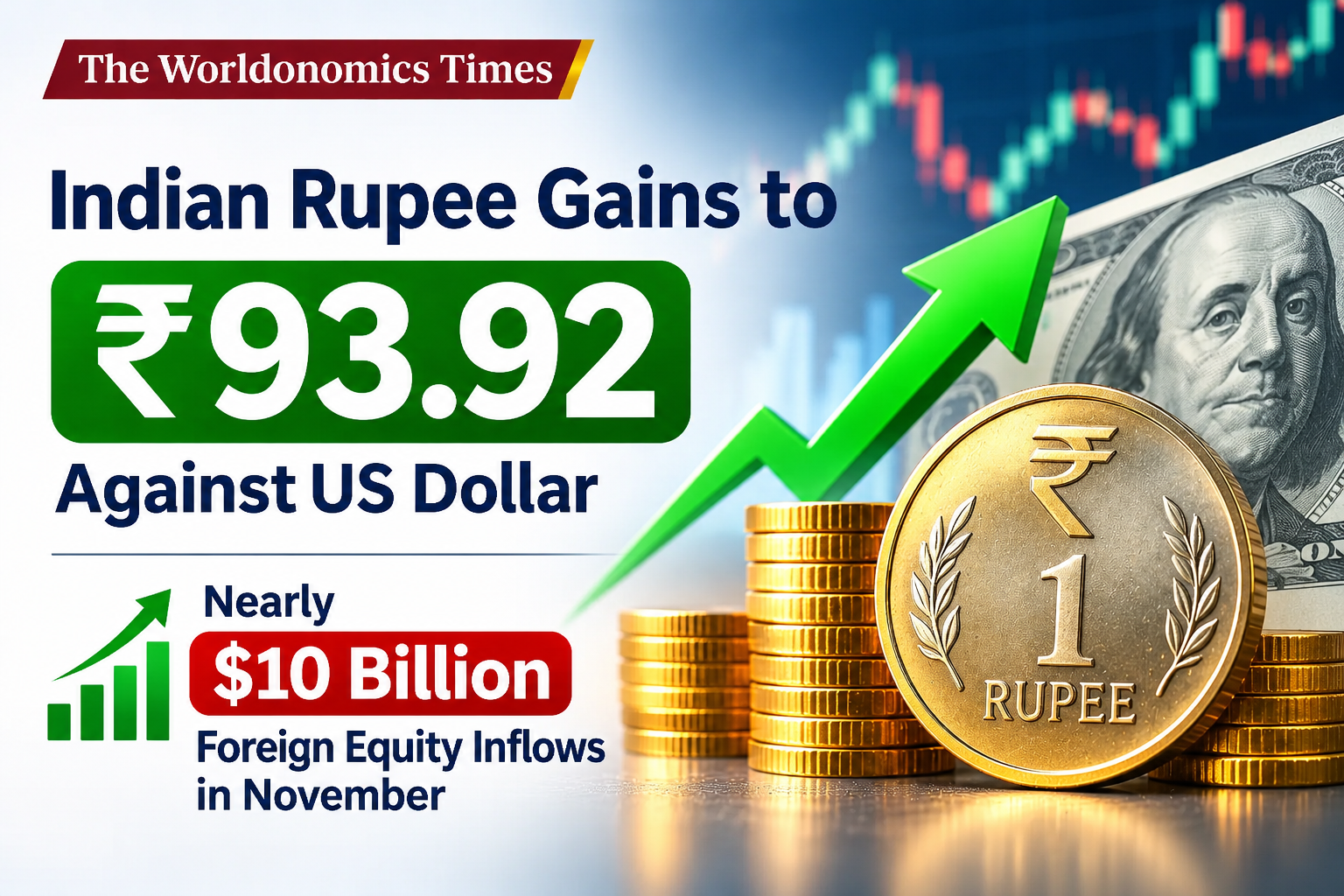
The Indian rupee strengthened 0.3% to 93.9225 against the US dollar on 16 November 2026, supported by strong foreign equity inflows and dollar selling by banks. Overseas investors have purchased nearly US$10 billion worth of Indian stocks in November, marking a record monthly inflow and providing support to the domestic currency.
The Indian currency recorded a notable recovery on Monday as foreign investment flows and easing global pressures supported the rupee. The currency appreciated against the US dollar despite continuing concerns over international interest rates, crude oil prices and geopolitical uncertainty.
According to Reuters, the rupee strengthened to 93.9225 per US dollar, outperforming several Asian currencies. The development comes after a period of volatility in the foreign exchange market.
The recovery is significant for India’s external economic position because currency movements influence import costs, export competitiveness, foreign investment and inflation.
Foreign Investment Provides Support to the Rupee
A major factor behind the rupee’s appreciation has been the return of foreign investors to Indian equity markets.
Overseas investors purchased nearly US$10 billion worth of Indian stocks during November 2026, representing a record monthly inflow.
This marks a significant reversal from the earlier period of foreign investment outflows.
Foreign portfolio investment can influence currency demand because overseas investors generally need to convert foreign currencies into rupees when purchasing Indian financial assets.
The increased demand for the domestic currency has therefore helped support the rupee.
Debt-market inflows have also continued, although at a more moderate pace. Reuters
Banking Flows and Dollar Selling Strengthen the Currency
Apart from foreign equity investments, dollar selling by foreign and private banks has also contributed to the rupee’s recovery.
Market participants attributed some of the recent dollar sales to custodial and corporate transactions.
The rupee’s one-month realised volatility declined to approximately 4%, compared with around 6% two weeks earlier. This indicates that currency-market fluctuations have moderated, although external risks remain.
The improvement in currency stability is important for businesses engaged in international trade, particularly those with significant foreign currency exposure. Reuters
Falling Oil Prices Offer Additional Relief
International crude oil prices are another important factor influencing the Indian rupee.
India is a major importer of crude oil, and higher petroleum prices increase demand for foreign currency to finance energy imports.
When international oil prices decline, India’s import bill may moderate, reducing some pressure on the country’s external payments.
Recent easing in oil prices from their earlier highs has provided additional support to the rupee.
However, geopolitical developments and volatility in global energy markets continue to create uncertainty.
What Does a Stronger Rupee Mean for the Indian Economy?
Currency appreciation can influence different sectors of the economy in different ways.
1. Importers: A stronger rupee can reduce the domestic cost of imported crude oil, machinery, electronics, chemicals and other commodities, assuming other factors remain unchanged.
2. Exporters: Export-oriented businesses may receive fewer rupees when converting their dollar earnings. This can affect profitability, particularly for companies with substantial overseas revenue.
3. Foreign Investors: Greater currency stability can improve investor confidence and reduce exchange-rate uncertainty when investing in Indian financial markets.
4. Inflation: A stronger currency can help moderate imported inflation by reducing the rupee cost of imported goods and commodities.
5. External Debt: Companies with foreign currency borrowings may benefit from lower rupee repayment costs, although the actual impact depends on their hedging arrangements.
RBI and India’s Foreign Exchange Management
The Reserve Bank of India plays an important role in maintaining orderly conditions in the foreign exchange market.
Currency movements are influenced by international interest rates, capital flows, trade balances, energy prices and domestic economic fundamentals.
India’s foreign exchange reserves also provide an important buffer against external financial shocks.
According to the latest available RBI data, India’s foreign exchange reserves increased by US$2.49 billion to US$719.55 billion in the week ended 6 November 2026.
The reserves provide protection against external-sector volatility and support confidence in India’s ability to meet international payment obligations. Business Standard
Global Interest Rates Remain a Risk
Despite the rupee’s recent appreciation, international monetary policy remains an important source of uncertainty.
Expectations of faster interest-rate increases by the US Federal Reserve could strengthen the dollar and encourage capital movement towards dollar-denominated assets.
Higher US interest rates may also influence investment decisions in emerging markets, including India.
Market participants are closely monitoring global central bank signals, crude oil movements and geopolitical developments.
If global financial conditions tighten, emerging-market currencies could face renewed pressure.
Outlook: Can the Rupee Sustain Its Recovery?
The near-term outlook for the Indian rupee will depend on the continuation of foreign investment inflows, international oil prices, US dollar movements and domestic economic conditions.
Sustained foreign portfolio investment could provide additional support to Indian financial markets. However, changes in global risk appetite may quickly influence capital flows.
For Indian businesses, currency stability remains important for planning imports, exports, international borrowings and overseas investments.
A relatively stable rupee can improve business confidence and reduce uncertainty in international transactions.
Conclusion
The Indian rupee’s appreciation to 93.9225 against the US dollar on 16 November 2026 reflects improving foreign investment flows and easing currency-market volatility.
Record foreign equity purchases of nearly US$10 billion during November have provided important support to the domestic currency.
However, the sustainability of this recovery will depend on global interest-rate expectations, crude oil prices, geopolitical developments and the direction of foreign capital flows.
For India, maintaining currency stability while attracting long-term foreign investment will remain an important element of external economic management.
Source: Reuters; Reserve Bank of India (RBI).
The Worldonomics Times | Global Economics & Financial Markets