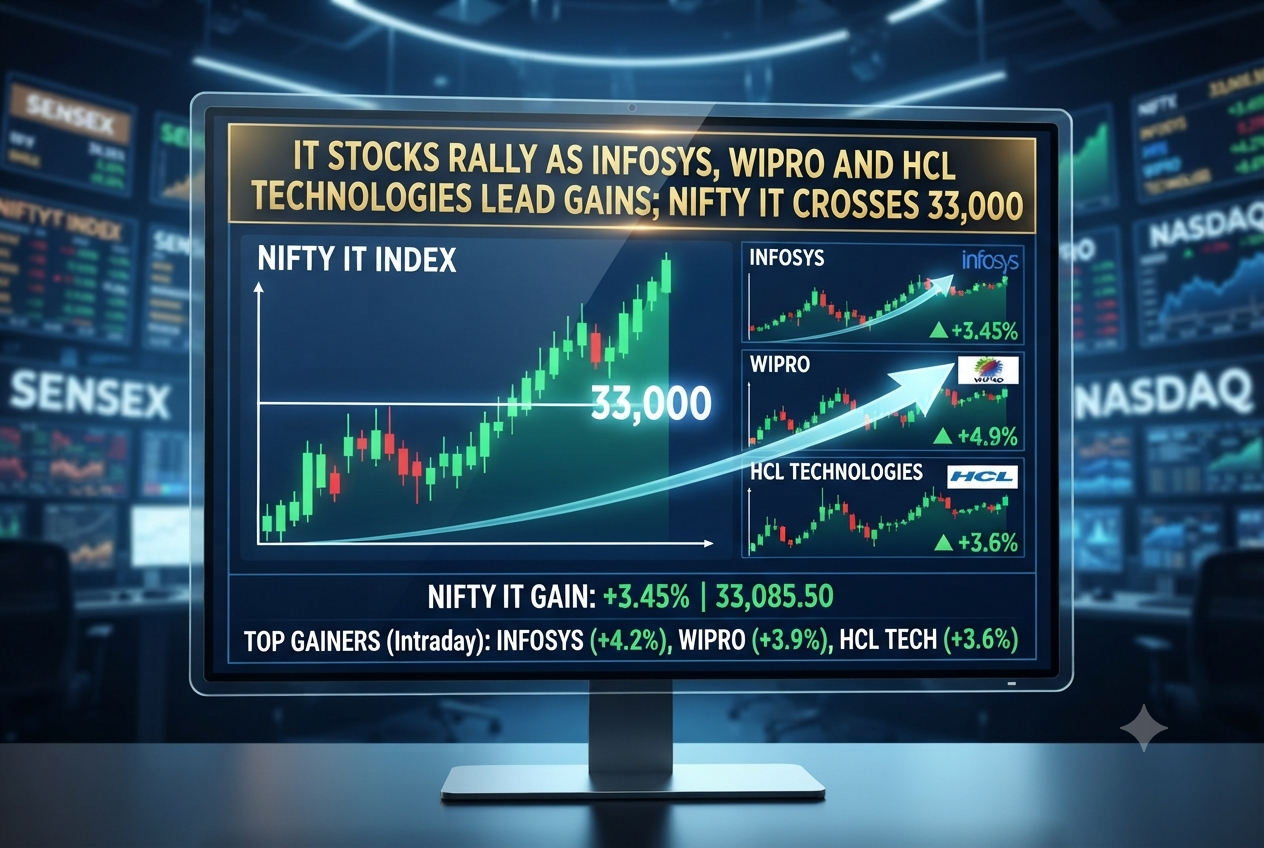
Indian information technology stocks witnessed strong buying interest on Thursday, November 26, 2026, as investors increased exposure to major technology companies amid improving sentiment towards the sector. Shares of Infosys, Wipro and HCL Technologies advanced, helping the Nifty IT index emerge as one of the strongest-performing sectoral indices during the trading session.
The Nifty IT index climbed more than 2% during the morning session, crossing the 33,000 mark and touching an intraday high of approximately 33,037. Wipro led the gains, while Infosys and HCL Technologies also recorded notable advances.
The rally reflects renewed investor interest in India’s technology services industry, supported by positive brokerage commentary on artificial intelligence (AI), corporate developments and continued foreign investor participation in domestic equities.
Wipro, Infosys and HCL Technologies Drive the Rally
Wipro emerged as one of the strongest performers among the major IT companies, gaining approximately 4.2% during early trading and touching ₹196.90.
Infosys and HCL Technologies advanced around 3% each, while Tata Consultancy Services (TCS) and Tech Mahindra also recorded gains.
All ten constituents of the Nifty IT index traded in positive territory during the morning session, indicating that the buying interest extended across the sector rather than being concentrated in just a few companies.
The strong performance helped the Nifty IT index outperform the broader market, attracting attention from investors looking for opportunities in India’s technology services sector.
Positive Outlook on Artificial Intelligence Supports Sentiment
One of the important developments supporting the rally was positive commentary from global brokerage Bernstein on the long-term growth potential of the IT services industry.
The brokerage highlighted the possibility of AI-led expansion in the global technology services market, estimating that the addressable market could grow from approximately US$1.5 trillion in FY2025 to US$2.1 trillion by FY2030.
It also expects India’s share of the global market to increase from approximately 13.8% to nearly 15% by 2030.
The outlook reflects the potential for Indian IT companies to benefit from rising demand for AI implementation, enterprise automation, cloud transformation and technology modernisation.
However, the opportunities may not be distributed equally across companies. Businesses with strong AI capabilities, specialised talent, established client relationships and the ability to deliver measurable productivity improvements could gain a competitive advantage.
Wipro’s Strategic Partnership With BP Adds to Investor Interest
Corporate developments have also contributed to the positive sentiment surrounding individual IT stocks.
Wipro attracted additional attention following news of a strategic partnership with BP. The development provided another reason for investors to focus on the company’s business opportunities and its ability to secure technology-related engagements.
Strategic partnerships can create opportunities for technology companies to expand their service offerings, strengthen client relationships and participate in large-scale digital transformation programmes.
For Indian IT service providers, relationships with global corporations remain important sources of business growth, particularly in areas such as enterprise technology, data analytics, automation and artificial intelligence.
The market’s positive response to Wipro also reflects the importance investors are placing on companies that can demonstrate meaningful business opportunities beyond traditional outsourcing services.
Foreign Investor Buying Provides Additional Support
The rally in technology shares has also coincided with a broader improvement in foreign investor sentiment towards Indian equities.
Foreign portfolio investors have reportedly invested approximately US$15.16 billion in Indian equities during November 2026, marking a substantial reversal from earlier selling activity.
The renewed inflows have supported benchmark indices and improved liquidity across several large-cap stocks.
Major IT companies such as Infosys, Wipro, HCL Technologies and TCS are important components of India’s equity market. Increased institutional participation can therefore influence their share-price performance and the direction of the Nifty IT index.
Nevertheless, foreign investment flows can change depending on global interest rates, currency movements, geopolitical developments and international market conditions.
Challenges Facing India’s IT Services Industry
Despite the recent rally, the sector continues to face several structural challenges.
One of the biggest concerns is the potential impact of generative AI on traditional IT outsourcing business models. While AI creates opportunities for new services, it could also automate certain activities that have historically generated revenue for technology service providers.
Pricing pressure and slower client spending remain additional concerns. Some global businesses continue to exercise caution when approving large technology budgets, potentially affecting deal conversion and revenue growth.
Brokerage assessments have also highlighted the possibility of an increasing gap between companies that successfully adopt AI and those that struggle to adapt their business models.
Indian IT companies will therefore need to invest in workforce training, specialised technology capabilities and new service offerings to remain competitive.
The challenge will be to convert growing demand for AI-related services into sustainable revenue growth and improved profitability.
What Investors Should Watch
The sustainability of the IT sector’s recovery will depend on several factors.
First, investors will monitor quarterly earnings and management commentary for signs of improving demand from major international markets.
Second, new technology partnerships and large client contracts could provide greater visibility into future revenue opportunities.
Third, companies’ ability to monetise AI services will become increasingly important. Investment in artificial intelligence alone may not guarantee higher profits unless it translates into commercial contracts and improved operating efficiency.
Finally, valuations will remain a key consideration. After several consecutive sessions of gains, investors may reassess whether share prices adequately reflect the industry’s growth prospects and risks.
The Worldonomics Times View
The latest rally in Indian IT stocks reflects improving confidence in the long-term prospects of India’s technology services industry. Artificial intelligence, cloud computing and enterprise digital transformation are creating new opportunities for technology companies, while strategic partnerships can strengthen their competitive positions.
However, the sector is entering a period of significant transformation. Traditional outsourcing models are evolving, and companies will need to demonstrate that they can generate new revenue from AI-driven services rather than simply absorb the technology into existing operations.
The distinction between technology adoption and commercial success will be critical. Companies that combine technical expertise, innovation, strong client relationships and effective cost management are likely to be better positioned for the next phase of industry growth.
For investors, the recent rally is encouraging, but long-term decisions should be based on earnings visibility, business fundamentals and valuations rather than short-term market momentum.
Conclusion
Indian IT stocks rallied on November 26, with Wipro, Infosys and HCL Technologies leading gains and the Nifty IT index moving above 33,000 during intraday trading.
Positive brokerage commentary on AI-led market expansion, Wipro’s strategic partnership with BP and improving foreign investor sentiment contributed to the favourable outlook.
While the technology sector offers significant long-term opportunities, sustainable growth will depend on companies’ ability to adapt to AI-driven changes, secure new business and maintain profitability in an increasingly competitive global market.