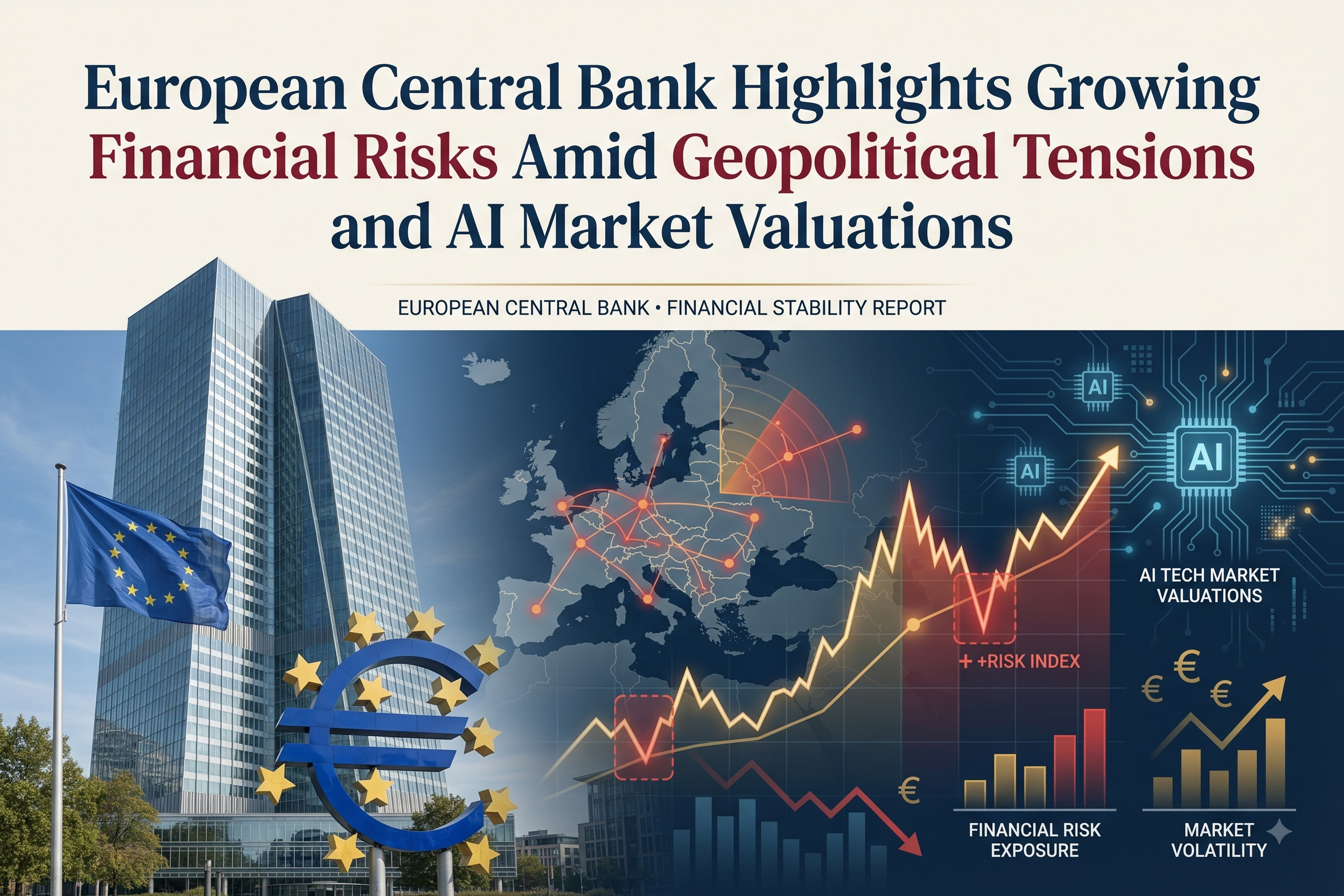
ECB warns that geopolitical uncertainty, rising government borrowing costs and elevated artificial intelligence valuations could create new challenges for Europe’s financial stability.
The European Central Bank (ECB) has raised concerns about growing financial stability risks across Europe, highlighting the potential impact of geopolitical tensions, increasing government borrowing costs and high market valuations associated with artificial intelligence (AI).
The warning reflects growing uncertainty in the global financial environment, where economic pressures, international conflicts and rapid technological developments are creating new challenges for investors, financial institutions and policymakers.
While European financial markets have demonstrated resilience in recent years, the ECB’s assessment suggests that vulnerabilities remain. Rising public debt, changing global trade conditions and potential corrections in highly valued technology stocks could create additional pressure on financial markets.
The central bank’s concerns underline the importance of maintaining financial resilience as Europe navigates an increasingly complex economic environment.
Geopolitical Tensions Increase Financial Uncertainty
Geopolitical developments remain one of the major sources of uncertainty for global financial markets.
International conflicts, trade disputes, economic sanctions and changing diplomatic relationships can affect energy supplies, international commerce and investor confidence.
For Europe, these risks are particularly significant because of its interconnected financial system and dependence on international trade and energy markets.
Geopolitical instability can increase commodity price volatility, disrupt supply chains and encourage investors to move capital towards assets perceived as safer.
Such developments may also affect European businesses by increasing operating expenses, delaying investment decisions and creating uncertainty around future demand.
The ECB’s warning highlights the need for financial institutions to evaluate geopolitical exposure and strengthen their ability to withstand unexpected economic shocks.
Rising Government Borrowing Costs Create Pressure
Another important concern identified by the ECB is the increase in government borrowing costs.
European governments face significant financing requirements related to public services, infrastructure development, defence spending and economic investment.
When borrowing costs increase, governments must allocate more resources towards interest payments, potentially limiting their ability to finance other priorities.
Higher sovereign bond yields can also influence borrowing costs across the wider economy.
Banks, businesses and households may experience higher financing expenses as government bond yields influence broader financial market conditions.
Countries with substantial public debt could face greater pressure if borrowing costs remain elevated for an extended period.
Additionally, concerns about government debt sustainability may increase volatility in sovereign bond markets and influence investor confidence.
Maintaining credible fiscal policies and responsible public debt management will therefore remain essential for European economic stability.
AI Market Valuations Raise Bubble Concerns
The rapid expansion of artificial intelligence has created significant investment opportunities across global financial markets.
Technology companies developing AI infrastructure, advanced semiconductor chips, cloud computing platforms and enterprise software have attracted considerable investor attention.
However, the ECB has also highlighted concerns about high AI-related market valuations.
Investors have placed substantial expectations on the future profitability of companies involved in artificial intelligence. While the technology offers considerable long-term potential, there is uncertainty about how quickly businesses will convert AI investments into sustainable earnings.
If company valuations become disconnected from actual financial performance, markets could become vulnerable to sudden corrections.
A significant decline in highly valued technology stocks could affect investment portfolios, institutional investors and financial institutions with considerable exposure to these companies.
The risk becomes more important when market optimism is concentrated in a relatively small number of large technology businesses.
Investors must therefore distinguish between genuine technological progress and excessive market expectations.
European Banks Face an Evolving Risk Environment
European banks remain central to the region’s financial stability.
Although banking institutions operate under regulatory and capital requirements designed to strengthen resilience, changing economic conditions can create new vulnerabilities.
Higher interest rates and government borrowing costs may influence banks’ funding expenses, lending activity and exposure to sovereign debt.
Geopolitical developments can also affect borrowers’ financial health, particularly in industries exposed to international trade, energy prices and global supply chains.
Meanwhile, financial institutions increasingly rely on digital technologies and AI-driven systems, creating additional operational and cybersecurity considerations.
Banks must maintain adequate capital buffers, carefully assess credit risks and strengthen their ability to manage unexpected market disruptions.
The ECB’s concerns highlight why financial supervision and risk management remain essential even when the banking system appears stable.
What Does This Mean for Investors?
The ECB’s warning carries important implications for institutional and retail investors.
Market participants may need to reassess their exposure to government bonds, high-growth technology companies and businesses vulnerable to geopolitical disruptions.
Investors should also pay attention to changes in sovereign bond yields, corporate earnings, credit conditions and broader market valuations.
Diversification across industries, regions and asset classes can help reduce exposure to concentrated market risks.
However, financial markets do not always respond predictably to economic developments. A combination of geopolitical uncertainty, changing borrowing costs and technology-sector volatility could create sudden fluctuations in asset prices.
For long-term investors, maintaining a disciplined investment strategy and focusing on underlying business fundamentals will remain important.
Europe’s Financial Stability Outlook
The European financial system is entering a period in which traditional economic risks are increasingly interacting with emerging technological and geopolitical challenges.
Government debt sustainability, international political developments and the rapid growth of AI investments will influence financial market conditions in the coming years.
Policymakers will need to strengthen financial supervision, encourage responsible public borrowing and monitor potential vulnerabilities in rapidly expanding technology markets.
At the same time, Europe must continue supporting innovation and investment without allowing excessive market speculation to undermine financial stability.
The ability of financial institutions and governments to respond effectively to these challenges will play a major role in determining Europe’s long-term economic resilience.
The Worldonomics Times View
The European Central Bank’s warning is an important reminder that financial stability cannot be taken for granted, even in advanced economies with established regulatory systems.
Geopolitical tensions, rising government borrowing costs and elevated AI-related valuations represent different types of risk, but their combined impact could create significant challenges for European financial markets.
In our view, the most important priority is maintaining a balance between innovation, responsible borrowing and financial discipline.
Artificial intelligence has the potential to transform industries and improve productivity, but investment decisions must be supported by realistic earnings expectations rather than market speculation.
Similarly, governments must manage public debt carefully to preserve investor confidence and avoid excessive pressure on national budgets.
For investors, the coming period calls for greater attention to diversification, corporate fundamentals and long-term financial resilience.
Ultimately, Europe’s economic strength will depend not only on technological progress and investment growth but also on the ability of its financial institutions and policymakers to manage emerging risks effectively.