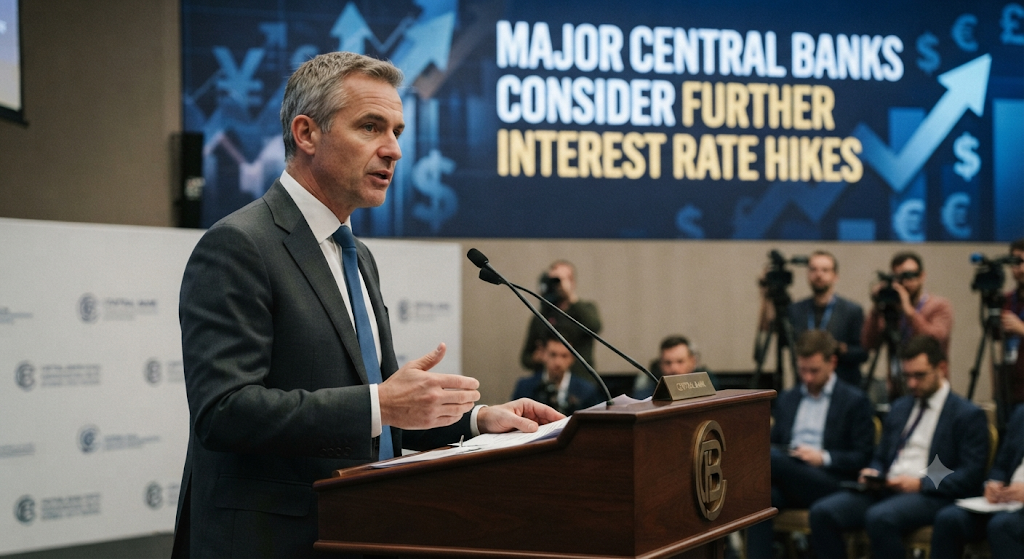
Federal Reserve, European Central Bank and Bank of Japan Face Inflation Challenges as Global Monetary Policy Remains Tight
By The Worldonomics Times Editorial Desk
The global financial landscape is entering another critical phase as major central banks continue to assess inflationary pressures, economic growth, and financial stability. The US Federal Reserve (Fed), European Central Bank (ECB), and Bank of Japan (BoJ) remain at the centre of global monetary policy discussions as policymakers evaluate whether interest rates need to remain elevated or rise further to control inflation.
Interest rate decisions made by these institutions have a significant impact on international financial markets, currency movements, borrowing costs, business investments, and consumer spending. As economies face different inflation trends and growth challenges, central banks must carefully balance price stability with the need to support sustainable economic activity.
Inflation Remains a Major Economic Challenge
Inflation continues to be one of the most important concerns for policymakers worldwide. Rising prices of essential goods, energy, housing, and services can reduce household purchasing power and increase operating costs for businesses.
Although inflation has moderated in some economies compared with previous periods of sharp price increases, underlying price pressures remain a concern. Wage growth, service-sector costs, supply-chain disruptions, and fluctuations in global commodity prices can make inflation difficult to control.
Central banks generally use interest rates as a key instrument to manage inflation. Higher interest rates increase borrowing costs, discourage excessive spending, and help moderate demand across the economy. However, these measures can also slow economic growth if maintained for an extended period.
US Federal Reserve Maintains Focus on Price Stability
The US Federal Reserve plays a particularly influential role in the global financial system because the US dollar remains the world’s primary reserve currency.
The Fed’s monetary policy decisions influence international borrowing costs, investment flows, currency markets, and financial conditions in both developed and emerging economies.
When inflation remains above the central bank’s desired level, policymakers may consider maintaining restrictive interest rates or tightening monetary policy further. However, the Fed must also consider employment conditions, consumer spending, business investment, and overall economic growth.
Higher interest rates can make mortgages, automobile loans, credit cards, and business financing more expensive. This may reduce consumer demand and encourage companies to postpone expansion plans.
For investors, the direction of US monetary policy is particularly important because changes in interest rates can influence stock market valuations, bond yields, and the attractiveness of dollar-denominated assets.
European Central Bank Faces Economic and Inflationary Pressures
The European Central Bank faces a different set of challenges as it manages monetary policy across the eurozone.
European economies continue to navigate concerns involving energy costs, industrial competitiveness, consumer demand, and geopolitical uncertainty. Inflation trends can also vary considerably between individual eurozone countries.
The ECB must ensure that inflation moves towards its medium-term target while avoiding unnecessary pressure on economic activity.
Higher interest rates can help control inflation by reducing borrowing and spending. However, they can also increase financing costs for households, businesses, and governments.
For European industries, particularly manufacturing and construction, the cost of borrowing is an important factor influencing investment decisions. If monetary conditions remain restrictive for too long, economic activity could weaken further.
The ECB therefore faces the challenge of maintaining price stability without creating excessive pressure on an already complicated economic environment.
Bank of Japan Navigates a Changing Monetary Environment
The Bank of Japan has a distinctive position among major central banks because Japan has experienced a prolonged period of exceptionally low interest rates and subdued inflation.
However, changing inflation patterns, wage developments, and movements in the Japanese yen have increased the importance of monetary policy adjustments.
A potential increase in Japanese interest rates could influence domestic borrowing costs and international investment flows. Japan is also an important participant in global financial markets, and changes in its monetary policy can affect currency valuations and capital movements.
A stronger interest rate environment could help the BoJ address inflationary pressures and support monetary policy normalisation. Nevertheless, policymakers must remain cautious because higher borrowing costs could affect household consumption, corporate investment, and government debt servicing.
Impact on Emerging Economies and Global Markets
Monetary policy decisions by major central banks have consequences far beyond their domestic economies.
When interest rates rise in the United States, Europe, or Japan, international investors may reconsider their investment allocations. Emerging markets can experience capital outflows, currency depreciation, and increased borrowing costs.
Countries that depend heavily on foreign investment or international financing may face additional economic pressure.
India and other developing economies must carefully monitor these developments because changes in global interest rates can influence exchange rates, foreign portfolio investment, import costs, and domestic financial conditions.
A stronger US dollar, for example, can increase the cost of importing commodities and energy for countries whose currencies weaken against it.
At the same time, higher global borrowing costs may encourage governments and businesses to become more cautious about international debt and investment decisions.
Investors and Businesses Prepare for Uncertainty
The possibility of tighter monetary policy is encouraging businesses and investors to reassess their financial strategies.
Companies may delay large capital expenditure projects, reduce borrowing, or focus on improving operational efficiency if financing becomes more expensive.
Equity markets may also experience volatility as investors adjust their expectations regarding corporate earnings, interest rates, and economic growth.
For ordinary consumers, higher interest rates can increase loan repayments and reduce disposable income. This may affect housing demand, automobile purchases, and spending on non-essential goods and services.
Consequently, the monetary policy decisions of major central banks will remain important indicators for businesses, financial institutions, and households throughout the coming months.
The Worldonomics Times View
The Worldonomics Times believes that the direction of global monetary policy will remain one of the most important factors shaping the international economy. Central banks are facing a difficult balancing act: controlling inflation without unnecessarily slowing economic growth or weakening financial stability.
The Federal Reserve, European Central Bank, and Bank of Japan must adopt carefully calibrated approaches based on their respective economic conditions. A uniform monetary policy approach may not be suitable because inflation trends, labour markets, consumer demand, and fiscal conditions differ across these economies.
Further interest rate increases could help contain inflation, but excessive monetary tightening may discourage business investment, increase household financial pressure, and weaken economic confidence. Policymakers should therefore carefully evaluate economic data before introducing additional restrictions.
Emerging economies must also strengthen their financial resilience by maintaining stable monetary frameworks, managing external debt, encouraging domestic investment, and reducing excessive dependence on foreign capital.
The Worldonomics Times believes that the ultimate success of monetary policy will depend not simply on controlling inflation, but on achieving a sustainable balance between price stability, economic growth, employment, and financial confidence.
The coming months will be particularly important for global markets as investors closely monitor central bank announcements and economic indicators. Whether policymakers choose further rate increases, maintain existing levels, or gradually ease monetary conditions, their decisions will have far-reaching consequences for the global economy.