Introduction
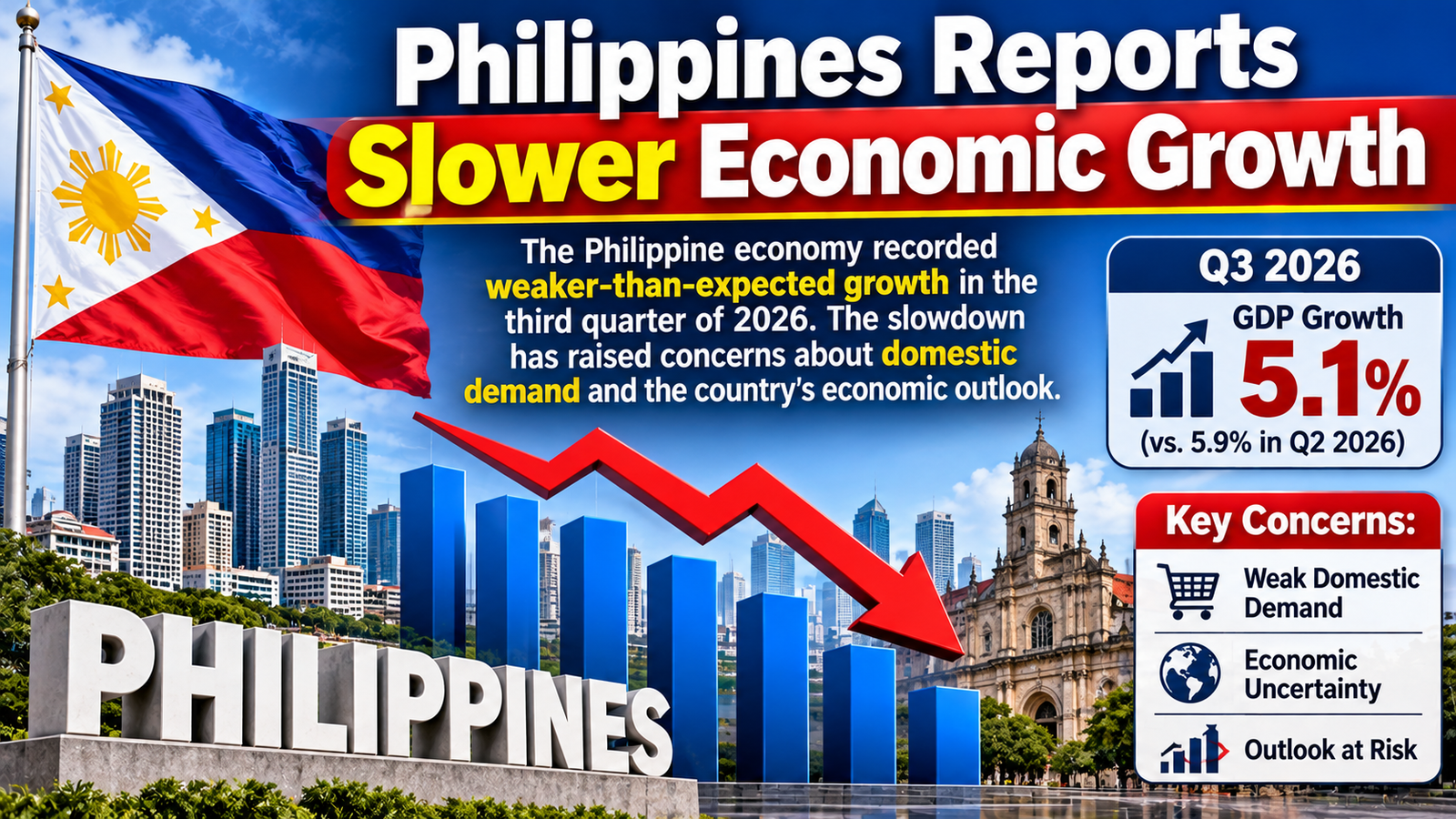
The Philippine economy is facing renewed economic challenges after recording weaker-than-expected growth in the third quarter of 2026. The latest figures indicate that economic activity has lost momentum, raising concerns about household consumption, industrial production, agricultural performance and the country’s overall economic outlook.
According to the Philippine Statistics Authority (PSA), the country’s Gross Domestic Product (GDP) grew by just 2.1% year-on-year in the third quarter of 2026, compared with 2.4% in the previous quarter and 4% during the same period last year.
The result was significantly below market expectations and represented the weakest quarterly growth since the COVID-19 economic crisis. The slowdown highlights the difficulties facing the Philippines as it attempts to maintain economic expansion amid rising living costs, weaker domestic demand and disruptions to productive sectors.
Philippine GDP Growth Falls Below Expectations
The third-quarter GDP figure of 2.1% indicates a significant loss of economic momentum.
Economists had expected growth of approximately 3%, making the actual performance considerably weaker than anticipated.
On a quarter-on-quarter basis, the economy expanded by only 0.1% after seasonal adjustment, highlighting the limited improvement in economic activity.
The latest figures also suggest that the Philippine economy continues to struggle with the effects of previous economic disruptions.
Although government spending and exports provided some support, the overall performance remained weak because household consumption and private investment did not generate sufficient momentum.
The slowdown raises questions about whether the country can achieve its broader economic growth ambitions without stronger domestic economic activity.
Weak Household Consumption Creates Pressure
Household consumption is one of the most important contributors to economic growth in the Philippines. However, rising living costs and pressure on purchasing power have affected consumer spending.
According to the PSA, household final consumption expenditure grew by only 2.4% year-on-year during the third quarter.
Higher food, transportation and utility expenses have reduced the amount of money available for discretionary spending. Many households are becoming more cautious about purchasing non-essential goods, delaying major purchases and managing their budgets more carefully.
This situation can affect businesses operating in retail, hospitality, transportation and consumer services.
When household spending weakens, businesses may experience lower sales, reduced investment confidence and slower employment growth.
Strengthening consumer purchasing power will therefore remain essential for improving the country’s economic performance.
Agriculture and Industry Face Major Challenges
The weakness in the Philippine economy was particularly visible in agriculture and industry.
Agriculture, forestry and fishing contracted by 4.8% year-on-year in the third quarter, while the industrial sector recorded a marginal decline of 0.003%.
Agricultural production was affected by unfavourable weather conditions, heavy rainfall and successive tropical cyclones. These disruptions damaged crops, affected infrastructure and created difficulties for farmers and agricultural businesses.
The decline in agricultural output is particularly concerning because it can influence food availability, rural incomes and domestic food prices.
The industrial sector also struggled to generate meaningful growth. Weak construction activity and uncertainty surrounding investment projects have affected industrial momentum.
These developments highlight the importance of improving agricultural resilience, strengthening infrastructure and encouraging private-sector investment.
Services Sector Provides Some Economic Support
Despite weakness in agriculture and industry, the services sector continued to support the Philippine economy.
According to the PSA, services expanded by 3.7% during the third quarter of 2026.
Wholesale and retail trade, financial services and public administration were among the important contributors to overall economic activity.
The services sector remains a major component of the Philippine economy, supported by consumer businesses, banking, tourism, telecommunications and business-process outsourcing.
However, the relatively moderate expansion of services was not sufficient to compensate for the weakness in other major sectors.
For sustainable economic growth, the Philippines will need stronger contributions from manufacturing, construction, agriculture and private investment alongside its established services industries.
Government Spending and Investment Remain Important
Government expenditure has played an important role in supporting economic activity, particularly when private-sector demand remains weak.
The PSA reported that government final consumption expenditure increased by 6.8% year-on-year during the third quarter.
However, gross capital formation, which measures investment in fixed assets and changes in inventories, declined by 0.2%.
The weakness in investment indicates that businesses and other economic participants remain cautious about expanding productive capacity.
Delayed infrastructure projects, uncertainty surrounding public spending and weaker private construction activity have also affected investment momentum.
For the Philippines, improving the efficiency of public expenditure and encouraging private-sector participation will be important for strengthening long-term economic growth.
Implications for International Markets
The Philippine economic slowdown could have broader implications for regional markets and international investors.
A weaker growth outlook may affect investor confidence, stock-market performance and demand for domestic financial assets.
Following the GDP announcement on November 9, the Philippine Stock Exchange index declined by 1.46%, while the Philippine peso also weakened against the US dollar.
The developments reflect concerns about economic growth, inflation and the possibility of additional monetary tightening.
For international businesses, slower Philippine growth could influence investment decisions in sectors such as manufacturing, infrastructure, consumer goods and financial services.
However, the country’s long-term economic potential remains supported by its young workforce, expanding services industry and strategic position within Southeast Asia.
What It Means for India
The Philippine economic slowdown also provides important insights for India and other emerging Asian economies.
India and the Philippines share several economic characteristics, including growing consumer markets, expanding services industries and increasing integration with international trade.
Slower Philippine growth highlights how inflation, weaker household purchasing power and insufficient investment can affect economic momentum even in developing economies with strong long-term potential.
For Indian businesses operating in Southeast Asia, changes in Philippine consumer demand could influence opportunities in information technology, pharmaceuticals, infrastructure and consumer products.
The situation also reinforces the importance of maintaining agricultural productivity, strengthening domestic manufacturing and encouraging investment.
India can draw an important lesson from the Philippine experience: sustainable economic growth requires a strong domestic consumption base supported by productive investment and resilient infrastructure.
The Road Ahead: Can the Philippines Restore Growth Momentum?
The outlook for the Philippine economy will depend on the government’s ability to strengthen domestic demand, improve investment activity and address challenges affecting agriculture and industry.
Public infrastructure development, improved agricultural productivity and stronger business confidence could help support economic recovery.
However, persistent inflation, high energy costs, weather-related disruptions and uncertainty surrounding public expenditure may continue to create difficulties.
The central bank will also face a challenging policy environment. It must consider inflationary pressures while recognising that weaker economic growth could make additional monetary tightening more difficult.
A coordinated approach involving fiscal policy, monetary stability, infrastructure development and private-sector investment will be essential.
The Worldonomics Times Views
The Philippines’ weaker-than-expected GDP growth in the third quarter of 2026 is a warning that economic expansion requires more than strong performance in a single sector. The contraction in agriculture, nearly stagnant industrial output and modest household consumption demonstrate the importance of balanced economic development.
Policymakers should prioritise agricultural resilience, infrastructure efficiency, employment generation and stronger domestic purchasing power. Public spending should be directed towards productive projects that improve long-term economic capacity rather than simply supporting short-term activity.
The government must also create an environment in which private businesses feel confident investing, expanding production and generating employment.
For India and other emerging economies, the Philippine experience offers an important reminder that inflation management, investment growth and domestic demand must work together to support sustainable development.
Ultimately, the Philippines has considerable long-term economic potential, but restoring growth momentum will require consistent policies, stronger productivity and improved confidence among households and businesses. The coming quarters will be important in determining whether the country can move beyond its current slowdown and return to a stronger growth trajectory.